


Latest News & Insights
Explore all MOSINTER GROUP company updates, exhibition news, chemical industry insights, product applications and technical articles.

Dissolvable Frac Balls: Compare the Hold Window and Clearance Endpoint
Compare pressure holding, seat passage and complete dissolution separately. Align geometry, fluid, temperature and test evidence before approving an offered type.
Read more
Sodium Metabisulfite COA: Separate Salt Assay from SO2 Equivalent
Read sodium metabisulfite assay and SO2 equivalent on the same stated basis; use conditional calculations without inventing a lot result or approval.
Read more
Zinc Sulphate Monohydrate vs Heptahydrate: Compare the Zinc You Buy
Compare zinc sulphate hydrates on zinc assay, reporting basis and delivered cost, then qualify impurities and process acceptance independently.
Read more
Sodium Citrate vs Citric Acid in Food Formulation: An Acid–Salt Trial Plan
Compare sodium citrate, citric acid and their blend in a controlled food-formulation trial while keeping grade, dosage and regulatory approval product-specific.
Read more
Fumaric Acid vs Citric Acid: Dissolution and Acidulant Selection
A formulation and purchasing comparison that separates dissolution, the required acidification result and the exact offered grade—without assuming an equal-weight replacement.
Read more
Monocalcium Phosphate vs Dicalcium Phosphate: Buyer Checks
Compare chemical form and assay basis before comparing calcium phosphate grades. Align supplier documents and sample acceptance instead of assuming MCP and DCP are equal-mass substitutes.
Read more
Sodium Silicate vs Sodium Metasilicate for Industrial Formulation
Metasilicate is part of the sodium-silicate family. Compare an identified grade and a stated reporting basis before changing an industrial formula.
Read more
PPWR in 2026: Chemical Packaging Checks for Importers
An EU-bound chemical order now needs a packaging question as well as a chemical specification. Before accepting a sack or drum offer, ask what the package actually contains, who is responsible for the packaging placed on
Read more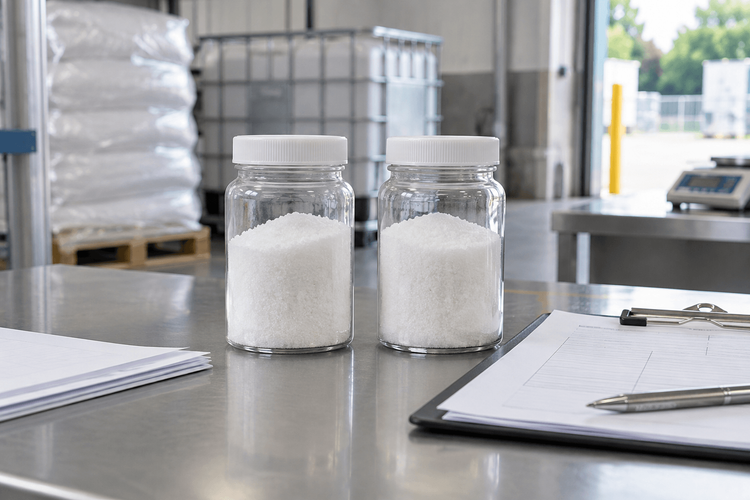
Citric Acid Monohydrate vs Anhydrous: How Buyers Compare the Two Forms
Monohydrate includes one water molecule per citric acid molecule; anhydrous does not. A pure-form mass conversion is calculable, but a purchase decision still depends on current grade assay, COA basis and process trials.
Read more
Ascorbic Acid vs Citric Acid: Food Processing Comparison for Formulators and Buyers
The early sourcing distinction is functional: citric acid is specified chiefly as an acidulant for pH control and tartness, while ascorbic acid is specified chiefly for antioxidant/quality retention in certain food systems. They are not one-for-one substitutes, and some validated formulations use both. This comparison covers decision boundaries, grade selection, validation trials, and the RFQ fields a supplier needs for food acidulant antioxidant procurement.
Read more
Sodium Bicarbonate vs Sodium Carbonate for Industrial Processes
Sodium bicarbonate and sodium carbonate are distinct process alkalis, and equal purchased mass is not an equal substitution basis. This B2B comparison covers chemical identity, specification checks, pH and neutralization targets, dose recalculation, incoming testing and pilot acceptance before a changeover. The current MOS catalogue verifies the two product identities, not grade-specific assay, performance or substitution suitability.
Read more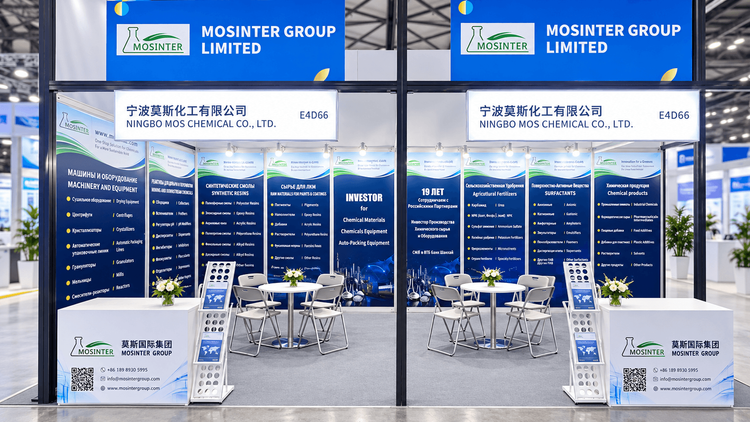
MOSINTER Group at ICIF China 2026: Exhibition Recap
A look back at MOSINTER Group's September 15–17 exhibition booth and the chemical and equipment portfolios presented there.
Read moreCompany Updates Are Being Prepared
No verified company news articles are currently available. Future operational updates, supply-network developments and corporate announcements will appear here after publication.
Contact MOSINTER GROUPNeed Product or Application Support?
Share your target product, required specification, order quantity, application and destination with our team.